
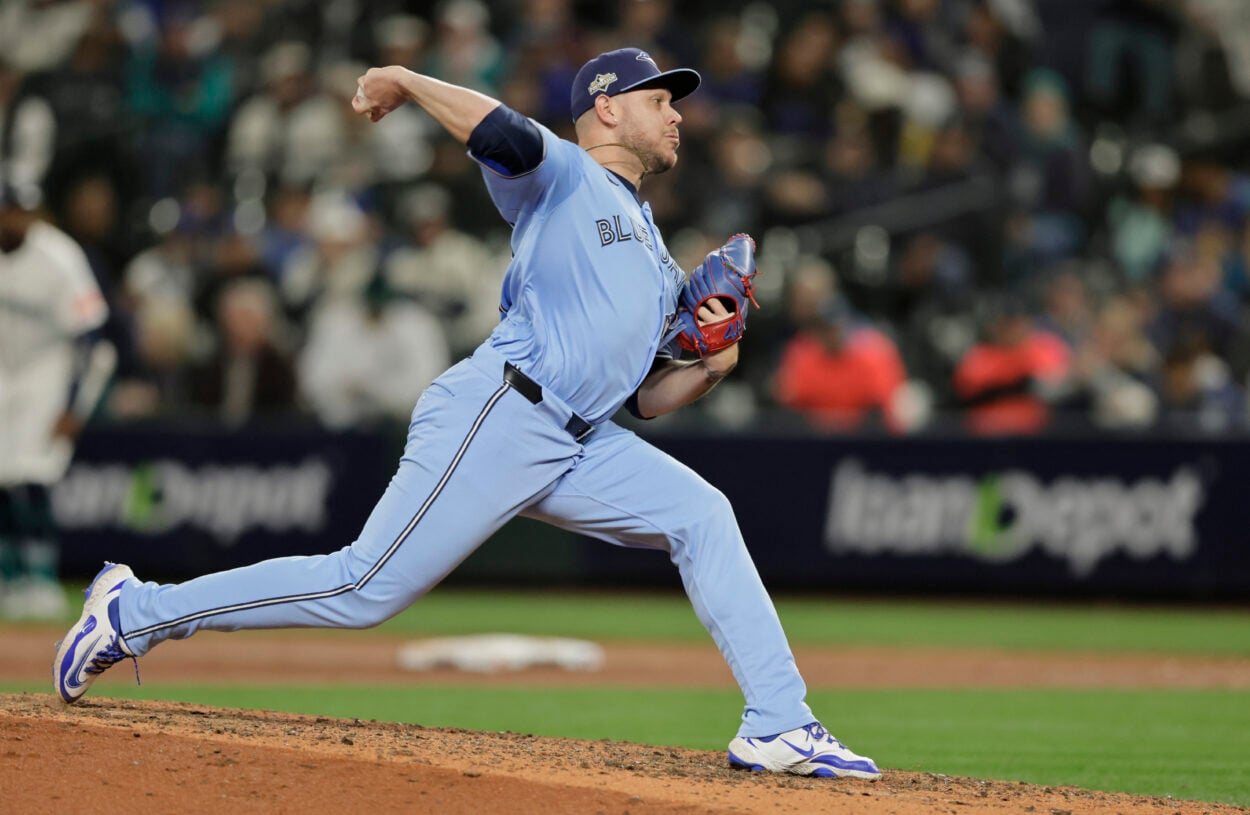
The Yankees have built a modern pitching factory on the premise that raw stuff is harder to find than control, and sometimes the market hands you a gift wrapped in a “Designated for Assignment” transaction wire.
When the Toronto Blue Jays cut ties with Yariel Rodriguez on Saturday, they weren’t just clearing a roster spot; they were admitting that his five-year, $32 million contract had become an albatross they no longer wanted to carry.
For a Yankees front office that prides itself on finding value in the margins, Rodriguez represents the exact kind of high-upside lottery ticket that often turns into October gold in the Bronx.
While the headline news in the bullpen market has been the departure of Devin Williams to the Mets, smart teams know that championship relief corps are built on depth, not just star power. Rodriguez is currently sitting on the clearance rack not because he can’t pitch, but because his previous contract made him untouchable on waivers. Now that he has cleared, the financial risk is nonexistent, leaving only the potential reward of a 28-year-old arm with intriguing metrics who is under team control until 2029.
The Matt Blake Laboratory Is Open for Business
If you look strictly at Rodriguez’s 11.4% walk rate from 2025, you might run for the hills, especially given how free passes plagued the Yankees last season. But savvy observers know that Pitching Coach Matt Blake eats profiles like this for breakfast: a pitcher with erratic command but electrifying stuff that generates weak contact.
Rodriguez ranked in the 95th percentile for average exit velocity and the 83rd percentile for hard-hit rate, meaning that when batters actually made contact, they were essentially hitting with a wet newspaper.
The underlying metrics suggest that Rodriguez is a few mechanical tweaks away from being a legitimate high-leverage weapon rather than a frustrating middle reliever. His ability to suppress slugging is elite, and in a ballpark like Yankee Stadium where fly balls go to die in right field, keeping the ball on the ground or inducing soft pop-ups is half the battle. If Blake can get him to simply pound the zone with his slider and splitter, the 3.08 ERA he posted over 73 innings last year could actually improve.
Why the Blue Jays’ Loss Is New York’s Gain
Toronto’s decision to eat the remaining money on Rodriguez’s deal is a testament to the brutal efficiency of modern roster management, but it creates a perfect storm for their division rivals.
The Yankees currently have David Bednar and Camilo Doval anchoring the back end, but the bridge to those closers is where games are often lost in August and September. Adding Rodriguez on a league-minimum deal allows the Yankees to allocate their remaining budget to other holes while still upgrading the middle innings with a guy who has proven he can get major league hitters out.
This isn’t about finding a new closer; it is about raising the floor of the entire unit with a pitcher who has proven MLB experience.
The Yankees need arms that can eat innings without getting shelled, and Rodriguez’s 1.4 WAR from the bullpen suggests he is far more valuable than the typical scrap-heap pickup. He is a distressed asset in the truest sense, and Brian Cashman has made a career out of polishing up players that other teams have given up on.
The Verdict: Make the Call, Cashman
There is simply no downside to bringing Rodriguez into camp and seeing if the change of scenery—and the change in coaching philosophy—unlocks his full potential. He offers cost control through his prime years, a fresh arm that hasn’t been overtaxed, and the kind of “uncomfortable at-bat” profile that plays up in the postseason. The Mets made their splash with Williams, but the Yankees have a chance to make the smarter baseball move by snagging a productive reliever for pennies on the dollar.
Opportunities to acquire 28-year-old pitchers with sub-3.50 ERAs without giving up prospects don’t come around often, and the Yankees would be foolish to let this one slip past them. It’s time to trust the scouting department and the coaching staff to do what they do best: turn another team’s castoff into a key piece of a championship puzzle.