
Bo Bichette isn’t just the most recognizable infielder available in free agency — he’s also the most intriguing.
At 28 years old, Bichette hits the open market at a rare intersection of prime-age production, positional ambiguity, and star power. He’s a former All-Star, a batting-title contender in his peak seasons, and one of the most consistent contact hitters of the past decade. He’s also a player whose long-term defensive home is no longer obvious — and that uncertainty may end up expanding his market rather than shrinking it.
This isn’t a free agency defined by projection. It’s defined by conviction. Teams won’t be guessing who or what Bo Bichette is. They’ll be deciding how much his bat is worth — and where they want it playing.
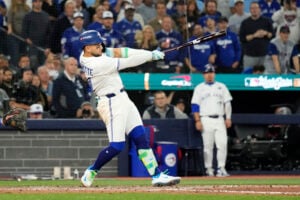
What Teams Are Really Buying in Bo Bichette’s Free Agency
Strip away the positional debates and defensive metrics, and the appeal becomes clear: Bo Bichette is still one of the league’s most reliable offensive infielders.
Bichette hits for average in an era that barely remembers how. He punishes fastballs. He doesn’t vanish for months at a time. When healthy, he forces pitchers into uncomfortable counts and lengthens lineups in a way that shows up over 162 games — not just October highlights.
Robert Murray’s latest on Bichette #BlueJays https://t.co/O7dqO65Yu9 pic.twitter.com/B1qVVVvmce
— Ben Turner (@benturn22) December 19, 2025
Defensively, the league has adjusted its expectations. Bichette is no longer viewed as a franchise shortstop you build around for ten years. Instead, he’s seen as something arguably more valuable in today’s game: a middle-infield bat who can move.
Second base. Shortstop in stretches. Even a hybrid infield/DH role as he ages. Teams chasing offense understand that elite bats don’t need to be boxed into traditional positions anymore. That reality reshapes his market.
Here are some possible landing spots for Bo Bichette in free agency as the offseason continues.
Toronto Blue Jays: The Familiar Ending
Toronto remains the most obvious fit — emotionally and structurally.
Bichette is homegrown, deeply connected to the fanbase, and still a central part of the franchise’s identity. Re-signing him would likely come with positional flexibility — possibly a move to second base — but his role would remain the same: lineup anchor, tone-setter, and one of the faces of the organization.
The challenge for Toronto is leverage. Letting Bichette walk means replacing elite contact production in a market that rarely offers it. That replacement would almost certainly cost more, both financially and in roster flexibility.
Projected Role: Everyday second baseman / occasional shortstop
Contract Outlook: 7–8 years, $210–240 million
Why It Works: Continuity, familiarity, and an offense that still needs certainty
New York Yankees: The Power Fit No One Wants to Face
If the Yankees want to make a statement, Bo Bichette is how you do it.
With Anthony Volpe entrenched at shortstop, New York could slide Bichette to second base (or even third) and immediately transform the lineup. His right-handed bat in Yankee Stadium would be relentless — spraying doubles into gaps, punishing mistakes, and protecting the heart of the order.
The Yankees have increasingly valued contact hitters to balance their power-heavy approach. Bichette fits that philosophy perfectly. He doesn’t need to be the face of the franchise — just a force multiplier in a lineup built for October.
Projected Role: Everyday second baseman, premium lineup bat
Contract Outlook: 7 years, $225–250 million
Why It Works: Stadium fit, lineup balance, win-now urgency
Chicago Cubs: The Quietly Aggressive Option
The Cubs have spent years building flexibility. Bichette would give them direction.
Chicago’s lineup has talent, but it lacks a true offensive engine — someone pitchers actively fear in big moments. Bichette provides that immediately, whether at shortstop or second base, and fits neatly into a roster transitioning from promise to contention.
The Cubs are also well-positioned financially to strike when the market aligns. This is the type of move that signals a return to serious October ambitions.
Projected Role: Shortstop or second baseman, lineup centerpiece
Contract Outlook: 6–7 years, $200–225 million
Why It Works: Offensive need, financial flexibility, competitive window opening
Los Angeles Dodgers: The Wild Card
The Dodgers rarely need anyone — but they’re never afraid to add.
Bichette wouldn’t be asked to carry the lineup in Los Angeles. Instead, he’d be another elite offensive piece in a machine designed to overwhelm opponents. His versatility would be prized, his bat protected, and his workload managed intelligently.
This is less about desperation and more about dominance.
Projected Role: Rotational middle infielder, high-impact bat
Contract Outlook: 5–6 years, $190–210 million
Why It Works: Positional flexibility, depth-first philosophy, championship leverage
So What Will the Contract Really Look Like?
Bichette’s deal will likely reflect a compromise.
Teams won’t pay him like a pure shortstop. But they will pay him like an elite bat entering his prime — because that’s exactly what he is.
Expect:
-
Length: 6–8 years
-
Value: $200–250 million
-
Structure: Front-loaded value with defensive flexibility baked in
In a league starving for offense, Bo Bichette represents something rare: certainty.
The Last Word
Bo Bichette’s free agency won’t be about where he can play. It will be about where teams need him most.
He’s not redefining shortstop. He’s redefining how teams value infield offense — and the franchises willing to lean into that reality will be the ones lining up to sign him.
The market won’t just be competitive.
It’ll be relentless.
Main Photo Credit: Dan Hamilton-Imagn Images
The post One Star Could Revive the Infield Market in Free Agency appeared first on Last Word On Baseball.