
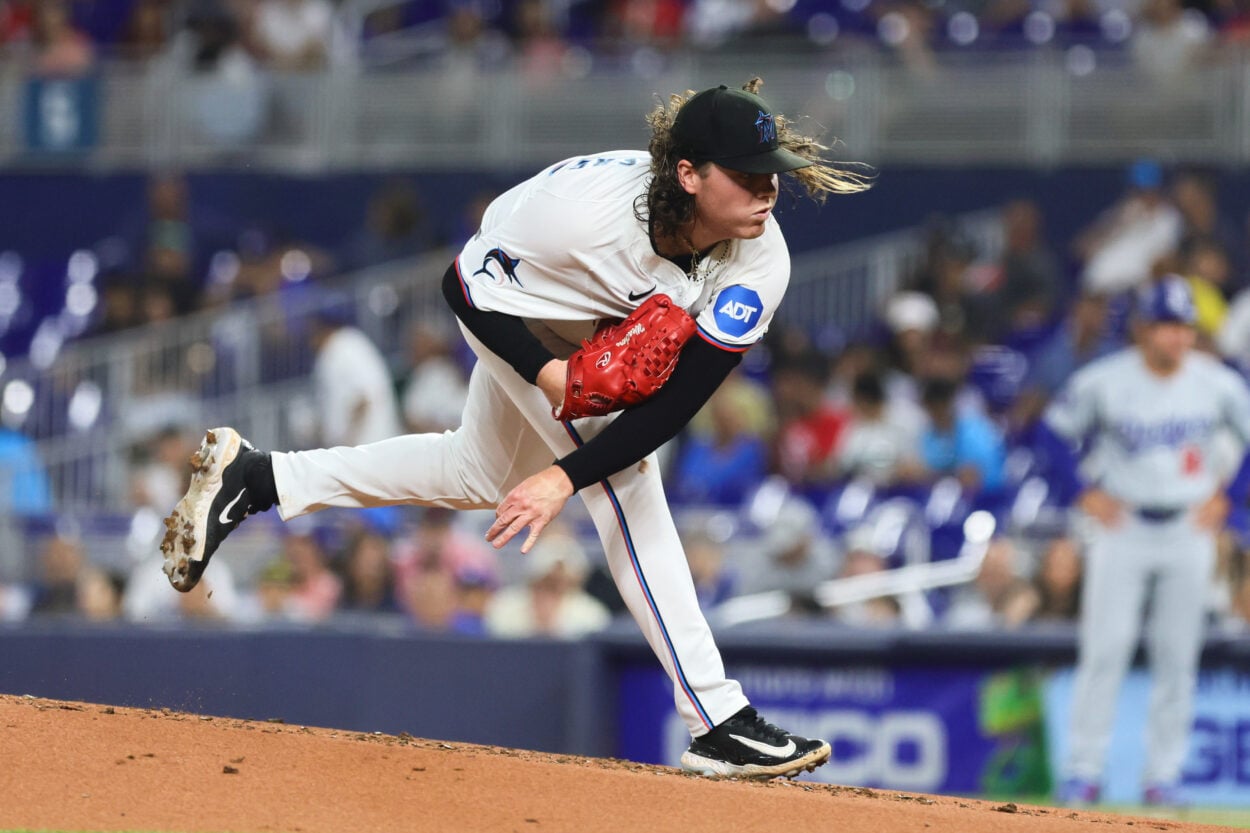
Last night the Yankees traded four prospects, headlined by outfielder Dillon Lewis, to the Miami Marlins for starting pitcher Ryan Weathers.
Safe to say, I’m not sure that many people expected this deal to go down as this was the classic out-of-nowhere addition that we’ve becomed accustomed to seeing from the front office in recent years.
Whether this ends up being the end of the rotation’s additions or not remains to be seen, but the talent here is easy to see if you watch a healthy Ryan Weathers.
His 4.93 ERA and 5.03 FIP in his brief MLB career (281 IP) would indicate this is not a pitcher fans should be excited about, but the repertoire and untapped upside could make this one of the better starters who end up getting moved.
READ MORE: The Yankees and Cody Bellinger feel destined to reunite in free agency
What Made Ryan Weathers an Attractive Trade Chip on the Market?
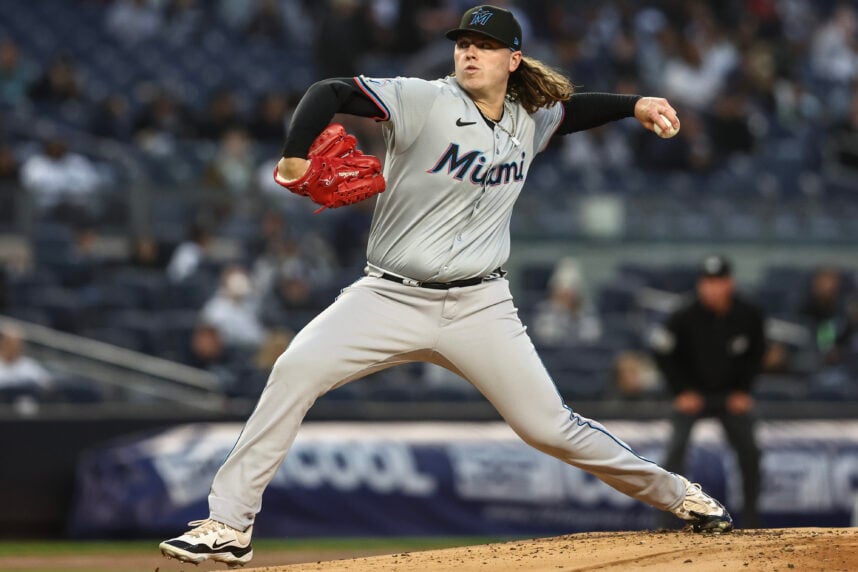
Ryan Weathers is essentially a three-pitch pitcher, using his four-seamer (45%), changeup (29%), ad sweeper (19%) nearly 93% of the time during the 2025 season.
He throws a power fastball with good vertical ride that had middling results last season, with this pitch serving the role of setting up the changeup and slider in two-strike counts.
These two secondary pitches are where the majority of Weathers’ strikeouts come from and they have tons of vertical separation off of his four-seamer, and the overall repertoire grades are pretty strong.
Eno Sarris & Max Bay’s Stuff+ model (which is available on FanGraphs) graded him out at a 103 in 2025, which is better than the league-average mark of 98 for starting pitchers.
At 26 years old, he’s younger than both Luis Gil and Will Warren which appeals to a team like the Yankees who have one of the better pitching development labs in the league.
With a 28.8% Whiff% this past season there’s a visual and statistical appeal to Weathers that makes him an easy breakout candidate to look at, but there are holes in his game that the Yankees need to address for 2026.
What Ryan Weathers Needs To Improve and Why the Yankees Are Perfect For His Development
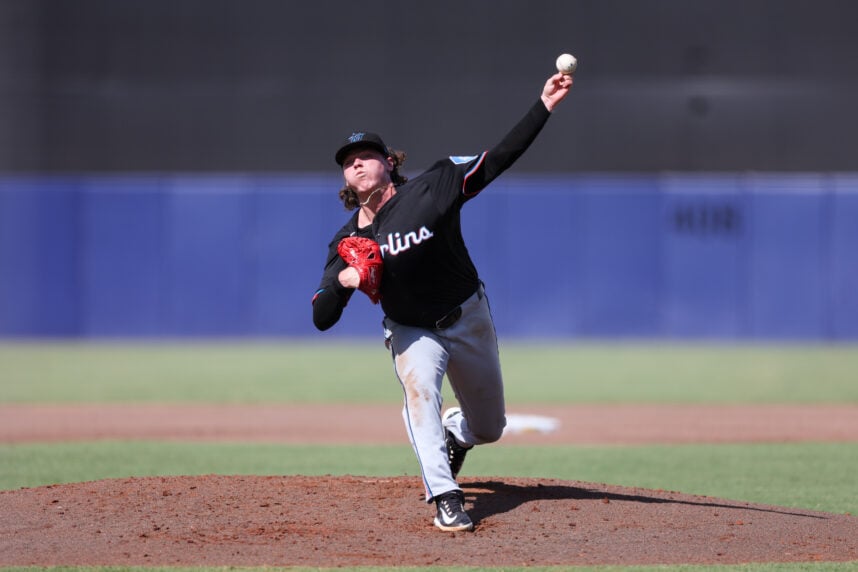
One of Ryan Weather’s biggest issues from last season was how well left-handed batters performed against his four-seam fastball, as it wasn’t a small-sample-size issue but rather a fundamental flaw in his pitch mix.
By relying only on one fastball and not having another pitch he can reliably attack the zone with, Weathers often finds himself getting ambushed early in counts since hitters know anything firm is a four-seamer.
Hitters are better than ever before at hitting velocity as a byproduct of the advancements pitchers have made to get more zip on their heaters, and its an issue that Carlos Rodon dealt with in his first two years with the Yankees.
During the 2022 season, Rodon had a 28.1% Whiff% and .285 wOBA allowed on his fastball, but in 2023 that fell off of a cliff and hitters crushed it to the tune of a .382 wOBA with a mere 21.7% Whiff%.
The swing-and-miss on that four-seamer never returned, so the left-hander made the adjustment by deepening his mix and throwing another fastball shape with a one-seam sinker in 2025.
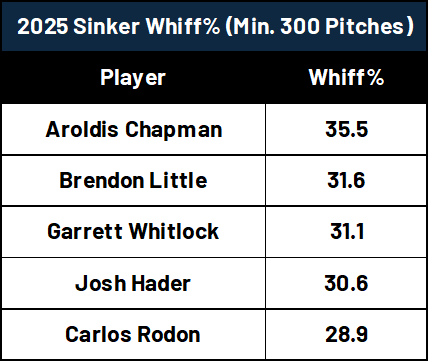
Carlos Rodon’s release bias and the way he applies pressure on the ball at release made it hard for him to throw a strong sinker in the past, but the Yankees were able to get him to throw a really good one by altering his grip.
Instead of relying on Magnus Force, which is movement derived from spin, Rodon was able to utilize Seam Shifted Wake which uses the way that the seams of a baseball interacts with the air to create movement.
The Yankees made a similar tweak to Max Fried’s sinker as well, resulting in four more inches of drop and a 60-point improvement in xwOBA from 2024 to 2025.
Ryan Weathers profiles as a pitcher who could use that second fastball shape to keep hitters, especially lefties, off of his four-seamer and give hitters another look they have to pay attention to.
2025 was the year of the mix as dubbed by Lance Brozdowski, and the Yankees embraced that during the season, which is something Weathers could greatly benefit from.
He already throws a sinker even if the usage rate on it is fairly low, but it gives me confidence that he has enough of a feel for spinning the ball into lefties and away from righties to potentially throw that one-seam sinker.
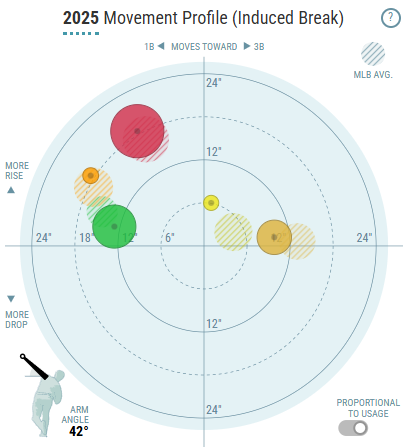
Looking at the already-existing mix, there could also be room for a cutter since his seldom-used slider doesn’t have a lot of depth and sits around 90 MPH.
If the Yankees could turn this into a 92-93 MPH cutter to have another toy to play with against lefties or righties, suddenly you’re looking at a five-pitch pitcher who isn’t throwing max effort fastballs 45% of the time every start.
That’s part of the suspected wear-and-tear issues he’s developed over the last two years in my opinion, as he’s thrown closer and closer to his max velocity and has to because his survival in-game depends on it.
Being able to dial it down a bit to ~95 MPH instead of ~97 MPH would be a great help for his ability to pitch over 100 IP, which he did fairly regularly before the 2025 season.
His four-seamer is still an important pitch and the goal isn’t to eliminate it or even make it a secondary fastball for him, rather the objective here is to give him pitches he can use to avoid being predictable and taking stress off the elbow.
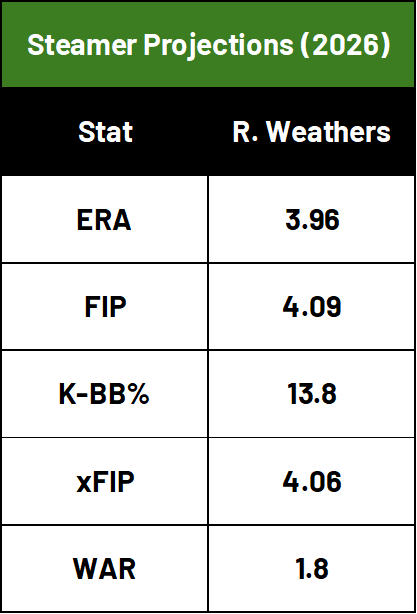
Without any improvements to his mix, Ryan Weathers is already projected to be a no. 3-4 starter for the upcoming 2026 season according to Steamer.
It’s not to say that this model is perfect or the objective baseline for his outcomes in 2026 without any wiggle room, but given that other public projections have him around there, the Yankees did make their staff better.
Ryan Yarbrough is probably not providing this for you in a rotation role and you needed another warm body who could make starts because their sixth starter entering Tuesday morning was Elmer Rodriguez, who has two Triple-A starts.
This deal becomes even more enticing if the Yankees could end up flipping someone like Luis Gil in a deal for a frontline starter such as Freddy Peralta (or someone else of that number two-ish quality) then they’re really cooking.
At the very least this is a team that added a quality starter who has the upside to really take off in 2026, and the changes needed for that to occur are not particularly large leaps in imagination.