
Ten years ago, in the summer of 2016, Noah Syndergaard didn’t just make his first All-Star team — he announced himself as one of the most overpowering pitchers in baseball.
A decade later, that season still feels cinematic.
At 23 years old, Syndergaard blended elite velocity with uncommon command, finishing the year 14–9 with a 2.60 ERA, 218 strikeouts, 0.97 WHIP, and 183.2 innings pitched. But those surface numbers only hint at how dominant he truly was compared to his National League peers.
Where Syndergaard Ranked in the NL in 2016
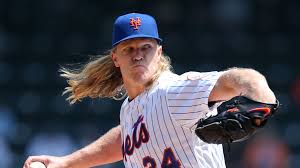
Among qualified NL pitchers in 2016, Syndergaard ranked:
-
3rd in ERA (2.60)
-
3rd in WHIP (0.97)
-
2nd in strikeouts per nine innings (10.7 K/9)
-
Top 10 in total strikeouts (218)
-
Top 5 in opponents’ batting average (.217)
-
Top 5 in FIP (2.29)
Advanced metrics loved him just as much as the eye test. His 2.29 FIP suggested he was even more dominant than his ERA indicated. Hitters weren’t squaring him up. They weren’t walking. They weren’t breathing comfortably in the box.
His fastball averaged nearly 98 mph and regularly touched triple digits — the hardest among starting pitchers that season. But what separated Syndergaard from other power arms was efficiency. He didn’t just throw hard; he located. His walk rate (2.1 BB/9) was elite for someone with that kind of velocity.
He wasn’t wild. He was precise.
The Theater of 2016

The 2016 season wasn’t just statistically dominant — it was dramatic.
In May, tensions with the Dodgers boiled over when Syndergaard opened a start by throwing behind Chase Utley. He was ejected immediately. The moment made national headlines. In New York, it made him iconic.
He pitched with an edge that season. The long hair flowed out from under his cap. The broad shoulders. The deliberate, almost theatrical pauses before delivering a 100 mph fastball. “Thor” wasn’t just a nickname — it was branding backed by performance.
And when October arrived, he delivered one of the defining performances of his career.
In the 2016 National League Wild Card Game against the Giants, Syndergaard threw seven shutout innings with 10 strikeouts and no walks. Under postseason pressure, he elevated. Every pitch had intent. Every two-strike count felt inevitable.
It remains one of the most dominant winner-take-all pitching performances in Mets history.
A Complete Ballplayer
Syndergaard even contributed with the bat in 2016, hitting three home runs and driving in 10 runs, finishing with a .225 average. For a pitcher in the National League, that was a bonus weapon — and a reminder of his athleticism.
He wasn’t just a flamethrower. He was a complete presence.
The “What If” Factor

Looking back 10 years later, 2016 feels like both a peak and a promise.
Injuries would soon alter his trajectory. A torn lat in 2017 limited him to seven starts. Tommy John surgery in 2020 cost him an entire season. The triple-digit fastball gradually dipped. The dominance became flashes rather than a constant.
He would later pitch for the Angels, Phillies, Dodgers, and Guardians — at times effective, at times searching for his old form.
But the 2016 version of Syndergaard? That pitcher looked like a perennial Cy Young contender.
At just 23, turning 24, ranking top three in ERA and WHIP in the National League while striking out hitters at an elite rate, he appeared poised to anchor the Mets’ rotation for years alongside other young stars. Instead, that year now lives as a brilliant standalone chapter.
The Legacy of a Luminous Year
Baseball history is filled with long careers and quiet consistency. But it also treasures singular, unforgettable seasons.
Noah Syndergaard’s 2016 campaign belongs in that category.
Ten years later, fans don’t first recall the injuries or the later stops around the league. They remember the heat. The swagger. The postseason dominance. The All-Star nod that validated what everyone already knew — that for one extraordinary year, Thor ruled the National League.
And for those who watched closely in 2016, the memory still feels electric.